Showing posts with label seoul. Show all posts

Tuesday, 9 November 2010

Lest We Forget


A poppy can lay dormant for years in soil, only for it to flourish when the earth is churned over. That’s why fields upon fields of poppies could be seen in France and Belgium after the World Wars. That’s why it stands for the memories of those who laid down their lives for us; those who churned the soil of fascism so freedom could bloom.

Jon Snow, the channel 4 newsreader has once again refused to wear one on air this year, saying he refuses to bow to ‘poppy fascism.’ A tragicomic image comes to mind of poppies marching on gardens, refusing to allow other flowers to bloom and shooting on sight all bees that work for any other plants.

He says that he doesn’t wear any symbol on air, pointing out that he doesn’t wear charity bands or black ties to mourn even those related to him. He is only interested in his journalistic impartiality. It’s a brave stance. However, it’s a stance he’s only able to take because of those who laid down their lives in such numbers so many years ago.

I wear pink on pink days, black for funerals and I wore a yellow band when my father was fighting cancer. There are more causes to support than colours. Wristbands have gone from plain, to multicoloured to pin badges. There’s even a Livestrong clothing range. Soon you’ll able to drive an animal rights car and live in an apartment that supports the fight against MS.

They’re all valuable causes, and Jon Snow is right when he says supporting one opens the floodgates to all. It conjures up the image of the news being presented by a giant slinky of multi coloured bands with a voice emerging from the top; ‘and the NASDAQ came down 3 points today.’

But a poppy means more. It means that we have the right to support any cause we choose to without reproach. It means I can write this blog, you can read this blog and people can write comments underneath; all without fear of being dragged away in the night.


In fairness to Snow, he has a job that does require impartiality, and he wears a poppy off air. For Abercrombie and Fitch and Bodycare UK there’s no excuse. Both companies banned their employees from wearing poppies simply because it isn’t part of their uniform. Do employees have to wear company approved underpants, socks, hair?

Why is it that some people seem so averse to celebrate their ancestors? Maybe it’s because we don’t make a big deal of it. Korea, USA, Australia and New Zealand all have national holidays to celebrate those who have died defending their nation. We just have bank holidays, and banks steal all our money.

A national holiday would give people the proper time to reflect on the bravery of those who have walked the extra mile for the most constructive or destructive of things, of that which is the hardest to sell; an ideal.

Over the next two days, if you walk past a poppy stall and debate whether to buy one, do you have time? Just remember 70 years ago, people just like you had no debate. 1,700,000 Brits laid down their lives over 9 brutal years. That number is too big to comprehend. Put simply, somebody British died every 3 minutes over both wars. That’s about the time it’ll take for you to buy and put on your poppy.

Tuesday, 2 November 2010

Christmas Is Coming, The Goose Is Not Yet Born


It’s November today, unless you’re reading this in the published form Lewis’ greatest blogs in the middle of July. Then it’s not November, but chances are the issue will be the same whatever the time: Christmas.

I should love Christmas. What’s not to like? People buy you stuff, you buy them things you’d like in return, maybe in the hope they won’t like it and just leave it hanging around for you to take home. There’s good TV. You can eat too much, drink too much and any inappropriate comments towards family will blamed on the rum content in the Christmas pudding and forgotten by the time the New Year comes in.

I get carried away by the excitement of it all and end up splurging vast quantities of cash on incredibly wasteful pre Christmas presents for myself. ‘Tis the season; I deserve an ivory carved back stretcher to go with my gold plated truffle chocolates.’ That’s fine when there’s 3 weeks of build up. My bank account can just about survive the onslaught.

When I walked through the local shopping centre last Monday (25th October) my heart sank. Christmas lights already. I couldn’t help it. A manic smile slowly started to form. Jingle bells began to be whistled. My hand reached for my wallet. Only 60 shopping days until Christmas, must ... buy ... crap.

Now I’m open and exposed. Everywhere is decorated; there’s no escape. Even the websites have festive trims. I’m like a heroin addict walking a world full of giant smack filled needles that I can just drop onto any time I like. I kid myself, that by using a card and not money it doesn’t count. But of course it does and I always end up spending the first week after New Year’s sobbing at my overdraft and eating Tesco value baked beans for every meal.

The Americans have thought this through. They have thanksgiving at the end of November. A nationwide family gathering where presents aren’t exchanged and cards aren’t bought. Everybody wins but the turkey. A staggering 46 millions turkeys get eaten in the USA each year at Thanksgiving. It’s a feathered genocide; 2 words I can’t imagine putting next to each other in many other contexts. It’s also the biggest evidence so far against evolution. Surely if the birds could evolve they’d have started migrating in October by now?

This mass consumption of gobblers means that people only start to think of Christmas when December arrives, and so none of the joy is lost.

By the time Christmas arrives here I’m all Christmassed out. Cracking and eating nuts has lost its novelty value, can’t stand the sight of tinsel, I’ll punch you in the face if you offer me another mince pie.

Each year Christmas seems to creep further and further back. Soon I’ll be eating Stollen in June, next year putting the tree up in March, to the point where I’ll be out buying things in December for the Christmas the year after.

Anyway, I must dash, there’s only 75,318 minutes left until the big day.

Tuesday, 19 October 2010

Chugg Off


On the occasional sunny days that Oldham offers me I like to wander into town to take my lunch. Despite walking through Oldham, it’s generally a pleasurable experience. I get to poke about in the market stall, ask the people in the pound stores how much everything is and if all that gets too much, I can sit on the one bench not covered in gum and bird shit just outside the court house and watch the comers and goers; this helps me feel smug and self satisfied about my middle class place in the world.

The main reason I cherish these days of splendour so much is that they’re so few and far between, so it was with joy in my heart when I trotted out of the office yesterday to spend 60 minutes of avoiding vomit, drunken maniacs and potty mouthed youths.

I walked up the high street not caring about the man with the lopsided beard asking me if I’d like to see his smelly bishop.

Then it happened. It loomed into view like a teacher coming into the class room as you’re mid white board graffiti. I froze. Mistake. They pounced on my weakness. It was a chugger. A charity mugger. They show no mercy.

For my American readers a chugger is one of those folks with a clip board full of pictures of puppies looking sad or children quietly sobbing. They wear a t-shirt for the charity they work for and generally some kooky accessories that make them look cool and worth talking to. They’re not, so don’t.


The conversation with a chugger usually goes like this.

“Hello Sir. You look like a generous kind of guy. My kind of guy. Your shoes are cooooool. Mind if I stop you for a minute to have a quick chat about my charity that helps middle aged women in Nantwich that have limited access to good Rioja?”
“Yes I do mind. Fuck off!”

Or rather I want to say that, but instead I just crumble like Cheshire cheese into a serving of meekness; ready for them to take advantage of. I mutter something along the lines of ‘no thank you, I don’t have time, please, I want to buy my lunch.’ But then they show me a picture of dying baby seals.

“See what happens when this 50 year old accountant’s assistant doesn’t have a nice glass of Bordeaux to help her through her meaningless existence? SEE WHAT HAPPENS?”
“YES, yes, I see. Please sobbing, please no more, take my money.”

And so I sign up and promptly cancel the direct debit. Promptly in this case meaning 4 months later, just in case they notice and send somebody round to my house with pictures of a shop selling kittens for drowning.

They’re masters at making you feel horribly guilty and that your life won’t be worth living unless you sign up to give £2 a month. Yet that feeling should be the other way round. Chuggers make £7 an hour for their part in this spreading of depression. That means that if you donate for a full year you’ll pay for a chugger to be on the streets for a full 3 ½ hours until a penny of your money goes to the charity.

This scam is just a transfer of money from your account to the account of another so they can stand about persuading people to keep the cycle going.

At this rate more people will be chuggers than aren’t and they’ll start fighting each other for your cash. Chuggers will climb down your chimney, claw at your windows. All the while saying could I just show you this?

So next time a chugger shows you their guilt book tell them you’ll consider their offer, and if, after consideration, you still want to donate, then you’ll access their website and donate there.

With enough of us doing it, maybe they’ll get the picture and chugg off.

Tuesday, 28 September 2010

Dentists

I’m thinking of refusing to pay part of my National Insurance. Before you judge me, it’s not in the same way that old people occasionally refuse to pay their council tax because they’ve not come to terms with the fact rationing has ended and bread costs more than a handful of cocoa beans. My reason is true and just, ironically, quite the opposite of the target of my ire: dentists.

If dentists take on NHS patients, then they get paid by the NHS, which is funded by National Insurance. An easy enough system; you might even go so far as to call it fair. Doctors, kind, caring, ever patient Doctors are paid by National Insurance donations, so we can live safe in the knowledge that next time we suffer from tennis elbow, jogger’s knee or footballer’s penis, we will be treated without judgement and for free. Not a penny. The Doctor will already have been paid.
That’s the case if the Doctor treats your leg, arm, or wherever you injured in that tragic fishing incident. They don’t discriminate.

Dentists, however, are a different breed. Despite only ever studying teeth, they manage to wrangle 7 years of study out of university. There are only 32 teeth, yet dentists study for the same amount of time as a Doctor who has to know every vein, muscle, bone and hair in the whole human body.

My last dentist appointment consisted of an angry looking man wielding a rather sharp object in the vague direction of the chair I was to sit in. He shone what seemed to a football stadium floodlight in my eye before beginning wrenching my jaw open, poking inside my mouth with a small sickle and muttering random letters and number.

“A 3, 47 K, QZ 8,962 and p -0.314.” His assistant wrote all this down, and then he poked a couple of my teeth with his finger, whilst sounding as if my mouth was some sort of construction site. “Hmmmmm, yes, mmmm. Interesting. I’ll just do a little scrape here, and lay some tarmac there.”
The scrape involved pricking my gums with the sickle until they started to bleed profusely. He barked at me, “your teeth are fine get out!” and I was sent on my way with nothing to stop the flood of blood, but a gargling of florescent green fluid that looked suspiciously like engine coolant.

For this quarter of an hour I was charged £15; a pound a minute. All of this despite the fact I was an ‘NHS patient.’ I protested that I’d already paid through national insurance, but then the dentist walked into the office wielding some sort of drill asking ‘is there a problem?’ It was like some sort of Russian nightclub charging me to leave.

The worst part of this is, if you’re only an NHS patient you get the equivalent of Tesco Value toothcare; braces made of corrugated iron and caps from papier-mâché. If you want your teeth fixed so they don’t fall out when you sneeze then you have to go private.

All that’s ignoring dental hygienists. Regular cleaners break their back to make sure entire hospitals are germ free and make £5 an hour. A dental hygienist has their subject sat in a chair at a comfortable height and takes 20 minutes to make £60.

Now if you’ll excuse me I have a class. When they leave I’m going to charge £20 each and tell them if they want a grade A they’ll have to go private.

Thursday, 23 September 2010

Stealing your soul, everyday

Supermarkets are shit. Travel to anyplace, at any time, speaking in any language and you’ll come to the same conclusion.

Ask an assistant in your local Asda what in season vegetables they have that will complement your black bream fillets, and they’ll most likely just point in the way of the fruit and veg section, whilst muttering to themselves ‘complement a bream? Vegetables can’t talk ... idiot.’

Ask the butcher in Tesco the best way to cook a brisket joint and watch them follow your lips moving, whilst starting vacantly, before moving onto the next customer and starting the whole procedure again. Rejoin the queue, ask them again and repeat the process continuously. After an hour or so you’ll be witness to a full mental breakdown.

On a side note. A butcher butchers. A market trader trades. Following this train of thought, a fishmonger mongs. What is monging? And why are the only two things you can mong, for a living at least, fish and iron?

Supermarkets specialise in food, and yet their entire staffs seem to consist of people who know absolutely nothing about food. Having worked in a supermarket myself, I’m aware that the requirements for the job are rather low. Surely asking a little knowledge about the store’s specialisation wouldn’t hurt?

Imagine going to a car showroom to ask an assistant how many miles to the gallon a Fiesta does, only for them to respond, ‘don’t know mate, I don’t like driving myself.’

Where possible I buy from markets. The food is cheaper, better quality and sold by people who actually know what they’re talking about, mainly because they care. If they don’t please then they don’t make money.

The other day I drove to Oldham market on my lunch break. Once a thriving community hub, now it resembles the scene of a local environmental disaster with everybody relocated. There were 4 stalls open, a stray dog and a hoard of giant mutant ants.

Even with such a sparse environment there was a charge to park. 80p for up to half an hour! I wanted to walk 20 yards to buy some fruit before walking back, and for the pleasure I had to pay 80p. The reason for Tesco’s domination of the grocery market revealed: free parking.

I was tempted to not pay, but an officer patrolled round patting a bat into his open palm. I was going to wonder how many people have to park before his wage is paid, but he didn’t look happy that I would even dare to think on his territory, so I just put the sticker in my window and hurried to the stalls.

I avoided the ants and a few stray tumbleweeds, but the dodging was worth it. Standing alone in the centre of the now deserted, once proud, country famous Tommyfield market was an oasis of edible delights.

The market stall was everything a food stall should be; rammed full of seasonal, locally grown produce, mixed with a selection of imports to choose from. The stall holder was a friendly bearded man, who took great pleasure in recommending various herbs that would go well with my vegetables. The food was well labelled and was a representation of the man selling it; a British Asian with a clear love for hot food, judging by the 7 varieties of chillies on offer in a multitude of difference shapes and sizes.

Proof that you shouldn't play with your food.

I was in my element, surrounded by great foods and somebody who could help me utilise them. It was a place that would be one of many in days gone by, and yet this champion of quality produce is facing a real struggle. His customer base was low before, but now the council, in their infinite wisdom, have charged people to park next to the market, reducing his income still further. People are expected to pay 80p just for the right to give him trade.

As so often in these cases the answers are infuriatingly simple. Scrap car park charges for people parking for under half an hour, and reduce rental rates on the market for food stall holders. The market is dead. It makes no money anyway, probably loses it considering they pay for somebody to ensure that nobody shops at their stalls. Slashing rental rates and removing parking fees will get people into the market, attracting shoppers and traders.

I can’t see it happening though. I reckon most of the councillors were trained by Tesco.

Thursday, 2 September 2010

Tony, Toni, Tone

Tony Blair’s memoirs are well on their way to becoming the fastest selling in British history. On pre sales alone it shares the top 3 current bestsellers with the autobiographies of Alistair Campbell and Peter Mandelson; we do love a good monster story in Britain.

Usually when somebody provokes such ill feeling as Blair, there are a number of reasons for it. Being hated to the point where a million march against you takes some doing. Thatcher stole industries, jobs, communities before she finally rose to full on hatred with the theft of milk.

With Blair, however, there was just Iraq. His smug smile was irritating. Hobnobbing with celebrities and pretending to be a football man both showed a man desperate to be liked, but nobody died. He was just a bit of a loser. That was OK though, people can deal with a loser when unemployment is falling, hospital queues are being slashed and the minimum wage is increased yearly.

Seeing 179 British soldiers dying to stop weapons that never existed managed to take Blair from OK loserish guy, to hated war criminal pretty much overnight.


On Parkinson Blair said he prayed to god for answers about the invasion of Iraq. He then went on to say “You realise that judgement is made by other people... and if you believe in god, it's made by god as well."

When I was at University there was a man who used to walk around the local town centre. He would collect cans, put them into a black bin bag liner and carry them to the same spot at the same time every night. There he would proceed to stamp on the bag and shout “BAD CANS, BAD CANS – THE DEVIL IS IN YOU AND HE MUST COME OUT, BAD BAD CANS!”
That man was unsurprisingly taken in for medical care after a few weeks. He was guided by the voice of god, and yet all that was damaged were a few cans.

There was also a Muslim student who used to tell people outside the student’s union bar that they were being judged by god; that bad things would happen to them in the after life if they continued down their path of sin. He was warned by the University not to go near the union unless he could keep quiet, and yet all he did was talk to us.

Strange then that when, guided by god, and passing judgement on his / her behalf, Tony order the invasion of Iraq and with it the death of 700,000 civilians, he was worried that people in Britain would think of him as a ‘nutter,’ because he was Catholic not Church of England.

Strange also that Blair would describe Gordon Brown as a man with ‘zero emotional intelligence.’ That from a man who patronised the British people so severely by stating they couldn’t accept a leader of another religion.


As thousands working in the public sector are currently looking over their shoulders, worried that they’ll be swept away in the next wave of cuts, one wonders what word they’d use to describe Blair, the man who instigated and authorised the spending of £9.24billion on invading Iraq.

The word ‘nutter’ comes to mind.

Thursday, 26 August 2010

Neighbours

Apartment living has its benefits: Heating bills are kept lower, there’s no garden up keep and you don’t have to negotiate any tricky steps when you’re drunk. However, it does mean your access to neighbours is limited to looking into their living rooms across the carpark.

During my time away in Korea our house was rented out. For the most part the tenant left it in one piece, however, a gardener he was not, and so my first job on returning was to tidy the garden as best I could. The first two priorities were cutting the grass and removing a vine plant that had gotten out of control. To do both jobs I borrowed a pair of blunt shears.

After hacking at the grass for some minutes I finally removed two blades. Exasperated I moved onto the vine plant. When I left England it was growing, but was a manageable size. Now it was a beast of epic proportions. As I removed leaves I saw the remnants of eaten plants, scores of crushed snails and the bones of next door’s cat that went missing. It seemed impenetrable, especially so since my tools had developed a layer of rust that chipped off only to reveal older rust. A Russian doll of rust lay beneath.

After an hour of squeezing leaves between the ‘blades’ my neighbour, whom I have never spoken to, offered to lend me her secateurs. The offending plant was massacred in minutes. My gloveless hands bled as it went down fighting, but I kept on. It went deeper than I thought possible. The inside was a graveyard of bugs, plants, snails, Russian spies. As I went under the leaves to cut the plant at its main stem I felt the branches closing in on me, but despite its best efforts I cut it down to the roots. All thanks to the kindness of neighbours, neighbours I never would have spoken to had I lived in an apartment.

Having said all that my other neighbour is a twat.

Wednesday, 25 August 2010

Going home

Korea was an easy place to live. 27 hours make a full time week, a meal out costs a fiver, beer is plentiful and work starts late. However, because of this, it isn’t the healthiest place. Like a tree’s age can be counted by its rings, generally you can tell how long a teacher has been in Korea by how many extra inches they have around their waist since they arrived.

Despite having an incredible year full of new experiences and new friends, leaving Korea, for my health’s sake at least, wasn’t all sorrow. Nobody wants to be the last to leave a party, but it’s hard to be the first.

(Perhaps the best ever song about going home, apart from Driving Home for Christmas by Chris Rea obviously)

Different people have different responses when it comes to the time to go. Some count down the days on their facebook walls as if the whole thing was a prison sentence. Some people cry, some people just stay. For the most part people are mixed like I was. Heading home my first feeling was joy at seeing my family. Actually my first reaction going home was ‘Finn Air – £500 for excess baggage – robbing bastards!!!,’ but after stealing a cushion and headphones from the flight, my sense of justice was restored and I went back to being happy at seeing my family. That was followed by sadness. Not at the end of the highlife, Korea is as close as one can be to being back at university, but without the need to eat baked beans for 42 days straight. I was sad at the fact that due to their homes being in USA, Ireland, Australia and Canada, I probably wouldn’t see my new found friends again.

With regular travelling people come and people go, and that’s part of the deal. You know you’re probably not going to see them again, so moving on isn’t hard. However to live in another country for a year means to put down roots. Friends are made and plans are made with them. Your life is a normal life, but in another country. When the time comes to leave that means not just leaving a country, but your friends, groups, plans, local bars, favourite restaurants, colleagues and hardest of all in my case, students.

The culture shock I experienced going to Korea was only eclipsed by the culture shock going back to England. In the spirit of easy reading, starting tomorrow, each day I’ll be posting the main differences between the two countries.

Tune in tomorrow for the first difference: neighbours.

Friday, 23 July 2010

A river ran through me


It’s said the Inuit have over 100 words for snow. Likewise we English have a whole collection of words for small body of running water with no obvious danger: stream, brook, spring, creek, course, rivulet, spate, pissflow. A river is something big, something to be feared and crossed on a bridge; to be looked at from a distance and admired.

A stream is where I got my running water kicks as a kid. I used to journey down brooks in my wellington boots. There was no need for waders; the water never rose above my toes, but still it felt like an epic journey each time I traversed the watery mile to the local tennis club.

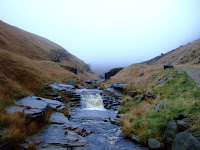
(The "river" Chew in Greenfield. My home village.)

I poked things with sticks, imagined huge waterfalls ahead, pushed my action man in his raft, generally anything but come to terms with the fact that I needed a friend.

I had to do the work in my head; we simply don’t have that many big rivers in England to stimulate the imagination. I put it down to generosity of spirit; with our 200 days of rain each year, we make sure that every village has a trickle running through it. Anything else would just be greedy.

That’s probably why I’ve never white water rafted before. The only white water I’ve encountered has been from industrial waste in the Thames.

When I heard it was done in Korea I had to try it. Before we travelled East to Inje, friends insisted the water would be calm; an easy introduction to the sport. Sadly it wasn’t to be. The day before, it rained as if an ark was needed. The whole sky was like an endless bucket being poured on all below it. The river raged up 2metres in a week, up a grade in a day.

It wasn’t a case of spotting the white water as we drove alongside the course, rather spotting the water that wasn’t. I could see all manner of rafting paraphernalia in the swollen water: paddles, helmets, arms.

I asked the instructor if it would be dangerous. He nodded.
“It’s safe ...... verrrrry dangerous.”
“So, it’s dangerous then?”
“No, not dangerous, just a little not safe.”

This carried on back and forth. The instructor looked at another instructor and they told me various contradictory statements about the safety, or lack of it, of the rafting. The safety class was similar. We were told what to do if we plunged into a rapid. “Turn around, head up river, feet down river. Be verrrrry calm.”I looked at the waves rising up then crashing down into holes 3 metres deep. It didn’t seem conducive to calmness.

We got in the boat and practiced in the one calm spot for 10 minutes. This involved the guide shouting various instructions in Korean, the rafters shouting them back, and the boat spinning 360 degrees. He seemed pleased with this and so we set off into the first rapids.

Lindsay and I shared a boat with a group of high school exchange students from Singapore. They were confident, articulate and spoke in 2 languages, flicking back and forth between English and Malay, often mid sentence. The country has 4 official languages. Maybe their fluency can be put down to education; maybe that 42% of the country is of foreign heritage. Whatever it is if Korea really wants to be serious in its efforts to become a bilingual country then it need look no further than Singapore as a working model.

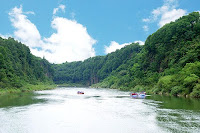
As we waited for the boat to drift to the first rapids and its doom I took time to look around. Cities in Korea are cramped, built upwards and generally devoid of any aesthetic pleasures. However, this does have a benefit. Much of the country is undeveloped, and in cities like Inje you can travel 10 minutes in a car and feel, as I did that day, like you are in true wilderness. Mountains rising up from rivers, entirely forested and seemingly full of adventures to be had.

(10 minutes from drive from the city of Inje brings you to this)

Then the rapids hit. We trashed our paddles around furiously, swayed from side to side, got soaking wet, but from the first swell I was hooked. There’s something extraordinary about being thrown about in a boat that is only comparable to when I’ve been mountain biking or fell running. You may not know entirely what you’re doing all the time, but that’s the draw card. You really don’t know what the result will be, because you don’t control every possibility. Nobody but nature does.

I started to get the hang of it, or at least I thought I did. We hit more rapids and guided through with no more damage than wet bodies. With 3 more rapids left we hit a big swell that rose the boat up and then dropped it mercilessly at what felt like a 90 degree angle. We all fell about, desperately clinging on. A girl was thrown overboard into the swirling abyss and the guide began to scream. Until that moment he’d be the epitome of calm. Perched precariously on the back of the boat and joking about. At one point I’m sure I saw him doing a handstand. Now though he seemed frantic. We were in the middle of a big rapid with a large slab of granite approaching. The problem with rocks is that they’re not in the habit of moving out of your way. Everybody grabbed what they could of the girl, whilst trying not to be thrown to the greedy river themselves. We finally hauled her on board and left her to lie at our feet.

She looked terrified. We managed to traverse the rest of the white water with no further incident, and it was then that I could consider the facts that make rafting so exciting. It really can hurt you. The water doesn’t help you out. It’s unrelenting, and so needs unrelenting respect and attention. That just deepened my addiction.

One of the best parts of outdoor sports compared to competitive sports is the removal of the competition. With that gone, your success doesn’t correlate to somebody else’s failure. It creates an atmosphere where people help each other out, and do their best to make sure you enjoy the experience. I looked up the river from our end point and the smiles were just the same as mine from boat to boat. If there’s ever a sport that sums up the spirit of Korean people, then it’s rafting.

Monday, 24 May 2010

Kari Bari Blog

It’s 1915 France. Trenches oppose trenches. Faces face faces. Guns point at guns. Europe is at a stalemate.
Neither team will give in. It’ll take 3 more years, 16,000,000 deaths and cultural devastation before the deadlock will be broken.
It could have all been so much simpler; if only somebody had uttered those immortal words: “rock paper, scissor!”

It’s 2010 Korea. Two students stare each other down in class. They want desperately to give each other Chinese burns, flicks to the face, water boarding; all manner of things considered illegal under the Geneva Convention. (Read: OK ways to kill other people)
On of them utters those immortal words: “Kari, bari, bo!”

Rock paper scissor, or kari bari bo, to give it its Korean name, carries genuine weight over here. If a standstill unfolds, a last pizza slice is being sought by more than one, or a decision about immigration policy is splitting the cabinet; there’s only one way to resolve things in Korea, and the people have it down to a fine art.
People limber up before hand; celebrate victory like a world cup. I saw one man running in the mountains training for a particularly tough rock paper scissor contest.

My students first educated me in the ways of kari bari bo (it must be said in full each time, to shorten it would only devalue the bo, although I have no idea which that one is) and I presumed it was limited to school debates over distribution of pain and reading duties in class (to many students those aren’t mutually exclusive events.)

However, I underestimated the cultural reach of the game. Soldiers will use it to distribute duties, professional men to decide who gets the final soju shot. MPs over what to claim next on expenses.

It really does take over everything.

Both of you want to watch a different film? Kari bari bo!
Not sure where to holiday this year? Kari bari bo!
Debating which oil laden Middle Eastern country to invade next? Kari bari bo!

Despite all this, the system would just fall apart were it not for the fact it is adhered to strictly. If somebody loses they will perform what is asked of them with no question.

I even read of a criminal ring that has recently emerged in Seoul, filled with people playing Russian kari bari bo, or ножницы утеса бумажные in native tongue. The winner takes all the loser’s possessions, whilst the loser is killed by the hand that beat them. I.e. death by either rock scissor, or rather more trickily, paper. Being paper cut to death is pretty high on my ‘top 10 list of ways not to die.’

Both Koreas are technically still at war, since no armistice has ever been signed. It’s surprising the whole thing hasn’t being solved by kari bari bo, although, to be fair, in Kim Jong-Il’s case it would most likely be rock scissor nuclear warhead.

So why not tale a little Korea culture into your life today? Next time you’re mulling over debates such as: spend or save, holiday or house, jump or don’t jump; take the stress out of life. Just limber your wrist, pull back your arm and utter those immortal words: Kari Bari Bo!

Sunday, 16 May 2010

Honesty in football ... no really

Not to sound smug about it, but my blogging has been tempered of late, due to the glorious weather we’re experiencing here in Korea.

It’s been hot, but not too hot, with a little wind and almost entirely dry; perfect weather for soccer, cricket, tennis – all manner of outdoor activities. And so it was that last week I found myself in a dingy student’s union with windows, playing ping-pong with a Jehovah’s Witness.

This isn’t a habit of mine, I was asked to play by a Korean friend going by the English name of Brian. Regular readers may remember him as the man who tries, on occasion, to convince me to believe blood transfusions are not needed during major surgery, and that snakes are capable of coherent conversation. Of course those of us with half a brain know all these beliefs have just plagiarised from Harry Potter.

Mental lapses aside, Brian is a nice guy, and so I agreed to play. In England, compared to the layman, I consider myself a decent table tennis player. Those who know their way around a table will most likely beat me, but those who ask what end of the bat to hold may fall to my less that dramatic spin. Brian claimed to be the same. I envisaged an even match. A gruelling encounter of Federer Roddick proportions. Two men sweating enough to rehydrate an African nation, grunting with all their masculine might; enough to make even the Williams’ sisters jealous.

It wasn’t to be. He destroyed me. The warm up went well enough. We traded gentle rallies, chatted between points, and occasionally during. It was all very lawn tennis. At one stage I found myself flirting with a vicar’s daughter whist Brian made us Pimms. I had found my calling card. A sport I could do without actually having to do much.

But then we started a real game. I took the first point and all was going well, but then Brian switched. Like the old man at the end of Street Fighter, he suddenly changed. Red ran into his eyes. He ripped his shirt through sheer muscle growth and began to scream. Then the massacre took place. I was well out of my depth in a sport that became scarier than I could imagine sport involving a 2gram ball could be. White bullets rained on me until 5 minutes later the torture was ended by a grinning Brian saying 11-1, do you want to play again?

He had told me he was only average, and the scary thing was, compared to other Koreans he is. I looked to the table next to me at two students having a quick rally before a night out. It took the ball stopping for me to realise there even was one. All I could see was a blurry white line linking their bats.

Ping Pong needs the kind of skills that Koreans excel at, the rest of Europe see as important, but we in Britain often struggle with in sport: technique, finesse and intelligence. Especially in football, the difference between Europeans and Koreans, is those skills are coupled with a strictly enforced honesty in Korea.

I play 5 a side on pitches around the city. The pitches have teams waiting around the edges and operate with 2 rules: first to 3 and winner stays on. There’s never a referee, but there’s no need. Honesty is expected, and so is self enforced. Handballs are admitted and fouls apologised for. In my entire time here I’ve played 5 a side over 30 times, and I’ve seen a disagreement once.

Teams order themselves on the side to determine who goes on next. There’s never a problem, just honesty. It truly is a fantastic thing to behold. Should the same thing happen in England, especially in a city centre, there would be arguments by the minute, voices raised as standard, and most likely a knife would enter the equation at some stage.

In 11 a side games, even with a referee, it’s exactly the same. Players won’t complain if they’re judged offside, they just get on with the game. There’s no nasty tackles ‘to let people know you’re there.’ If they handball and the referee doesn’t see it; no problem, it’s admitted to anyway. People here remember football is a game, to be enjoyed. The result won’t change a thing, and as long as they’ve given their all, which their tremendous work ethic demands they do, Koreans don’t let it change their mood either.

The best part is: it’s infectious. You can’t help but do the same. When such standards are expected as the norm, it creates an environment where you don’t want to look like the worst person on the field, an environment where nasty fouls aren’t cheered by small minded thugs, but condemned by all those watching; the perpetrator made to feel, rightly so, guilty.

In Korea, football really is the beautiful game, honestly.

Thursday, 22 April 2010

I bang, you bang, we all bang for Nori-bang


Before I start this blog I need to make one think very clear. In England Karaoke is a four letter word, a word that carries with it images of drunken dads and childhood fears. As a child, if I’d been particularly naughty, my mum would chase me round the house with a microphone shouting ‘Karaoke. Sing Lewis sing!’ I still wake up screaming at the thought, but the screams are out of tune of course.

As the years passed my hatred of the ‘k’ word and everything it stood never diminished. At one stage I started a political party whose sole aim was to get karaoke removed from Britain at the earliest given opportunity. To promote it would be a crime, indeed I suggested if someone were to be caught singing out of key into a metal box, then the culprit should be stoned to death.

But then I got to Korea. I’d heard about nori bangs (translation, singing rooms) and this seemed like a liberal compromise. Let people butcher well known classics, but in a private room out of my way. It was a perfect solution.

The strange thing about karaoke is that it falls into a polarised market. The two groups it appeals to are firstly teenage girls, and secondly pissed up middle aged men in bars, who still haven’t quite got over the fact that they won’t be rock stars. Credit where it’s due that’s a tough pair to find common ground with; teenagers and older men who find solace in drink. The catholic church have done their bit, but I’m not sure that’s quite the same as the karaoke angle.

And so, as the first few weeks in Chuncheon passed, I was blissfully karaoke free. Bars never have nights devoted to it. I have no younger family here to suffer it at birthday parties with. All was good and well in the world, knowing that karaoke was safely being performed behind closed doors.

Then there was Haiti. If it was wasn’t for the disaster in Haiti then I may never have sung, may never have fallen into the spiral of nori-bang addiction, from which I feel there is no way back.

I should explain. To raise funds for the tragedy Neill, a friend of mine, organised a singing competition at a particularly large nori-bang. A nori-hall if you will. To generate much needed cash we were to sing in front of each other, and the worst bit was, we had to pay for this ritual humiliation.

I felt sure the last thing homeless, starving people wanted was a bunch of foreigners in Korea taking apart other people’s musical back catalogues on their behalf, so I suggested just giving the money, but people seemed to think that made me some kind of miserable bastard, and so I signed up. I agreed to go along, thinking I would hang at the back of the room and ride out the whole experience, drink myself into a stupor and listen to my iPod, to music how it should be sung.

Sadly it wasn’t to be. I was seen, trying not to be seen. I was told I had to choose a song, or the song would be chosen for me. Fearing an hour on stage having to sing Bohemian Rhapsody in its entirety, I looked frantically for the fire exits. Why couldn’t they show us before we started? Surely it’s more use to know your way out of a 3 story building than a piece of metal suspended 2 miles above the ground?

During my scanning I found no way out, but I did see a friend was doing the same. He looked panicked, frightened, as if he’d just been told he was to be tortured to death unless he could fix a rubix cube in the next 5 minutes. I had found my companion. We both had nowhere to run.

I sloped over to Matt and asked him if he wanted to go through the experience together. Brothers in arms on a long road to ruin. (You see what I’m doing with these links?) He agreed and so we selected a song. It was to be ‘Copa Cabana.’ It was to become our signature. When Korea is long gone, we’ll always have the Copa.


We battled through, not once but twice. We were so bad we ‘won’ last place, and so were asked to perform again. I had no hesitation. I’d been through to the other side. (Incidentally, there’s over 10 songs called the other side, must be a good place to go) I’d looked fear in the face and laughed out of key at it. We were heroes and there was nothing anybody could do to stop us.

It’s hard to explain why nori-bang has captured me, whilst karaoke has left me feeling born to run (I admit that was tenuous) Perhaps it’s the fact it’s in a room, away from prying eyes. Perhaps it’s the fact there’s no night clubs in Chuncheon, or rather there are night clubs, but most don’t allow foreigners in. I can only think they’re scared of making a profit, because on the few times I’ve made it inside, they have been cavernous holes devoid of life or atmosphere. After drinking and talking in bars, I like to listen and dance to good music. Nori-bang has filled that vacuum.

Maybe, it’s just because for that night, in own mind at least, I’m a rock and roll star.

Since this was published Lewis and Matt have become regulars on the Nori-bang circuit, singing along terribly to various genres of music. The most eventful being renditions of Virtual Insanity by Jamiroquai, as it involves moving furniture around the room in a desperate effort to recreate the video. To recognise their efforts in pushing back the boundaries of nori-bang, Lewis and Matt have been awarded numerous hangovers and Sundays filled with regret.

Wednesday, 14 April 2010

This Blog Won't Be Cheap


In England my trips to the mechanics generally go as follows:

“You see the problem is your carburettor is disconnected from your left oesophagus.”
“Sounds like a medical problem.”
“And if you want it fixing you’re going to have to get a new grease alligator to fix onto to your manhole kahuna.”
“I’ve no idea what you’re talking about.”
“I can do it, but you’ll have to come back last Tuesday.”
“I want to leave here.”
“You see the problem with these things is that koala ectoplasm isn’t what it used to be. I’m going to have to charge you for the manhours, and with the Phillipino Peso at such a low rate well... it’ll be costly.”

And so it continues until my eyes glaze over and I offer my bank card in meek surrender, knowing that I won’t be able to afford food for another three weeks.

In Korea that hasn’t been a problem. I don’t have a car, and I have no plans to get one. Mainly because I won’t be here long enough, but also because driving seems to be acceptable as part of multi tasking. Drivers switch between lanes at will, generally whilst they concentrate on talking on the phone, watching their in car TV, checking their shoes for dirt marks, generally anything as long as it takes their minds off the distraction of the other half tonne chunks of metal driving at 50 next to them.

The low point for me was when a taxi driver fell asleep when heading towards a parked up truck. I woke him with a vigorous shake, pointed at the truck and sat back shaking my head in anger. He simply shrugged and looked rather miffed that I’d interrupted his power nap.

Still, that is a small price to pay for not having to visit the dreaded mechanics. I have, however, come into possession of a scooter. I’m looking after it for a friend of mine whilst he takes some time to see his family in the States. It helps me get around, usually whilst swerving from oncoming cars, but still I’ve managed to stay alive thus far. Although at times I have felt like I’m in a real life version of the frogger computer game.


Now, whilst my knowledge of car engineering is admittedly poor it’s not my worst quiz topic. I’m far more ignorant about the inner workings of women, Indo-Polynesian tribal languages, and scooters. So there was great panic when my scooter stopped working. This meant only one thing; a trip to the mechanics.

I arrived at Win Bike earlier today, and whilst there was no opportunity to enter any competitions, there was the familiar sight of a man in oiled overalls. Generally this is followed by a look of disdain, but this man smiled, wandered over and pulled my scooter into his shop.

I followed him experiencing the age old waves of nausea. Expect this time I couldn’t communicate anything. I was truly at his mercy. No longer could I mutter ‘£37,845 seems a bit steep’ before being shot back into place. It might not do anything, but at least I can feel I’ve put up a fight.

He opened the bike up and pulled out numerous parts, of which I have no idea of the names. One of them looked like a belt. He flexed this until it broke, before showing it to me and saying ‘broken.’ The walls started to close in again. I knew this feeling and there was nothing I could do to stop it. He had me at ‘mmmmm, broken.’ I was his toy now, to play with and toss away at will, with a monstrous invoice following soon after.

He started to replace the old parts with slightly shinier versions. He took a nut wobbled it about in front of me. When he replaced it with a new nut, his left hand held it firm so when he tried to wobble it again, it wouldn’t. This was going to cost me. I was going to cry; I could feel the tear ducts welling up.

So, when the whole ordeal was over, 20 minutes later, I was amazed. 45,000won, £25 in real money. £25 for new parts and labour. That would buy me a crushing handshake and a ‘this car needs scrapping’ in England. I couldn’t believe it, and so I scootered home just as fast as my polished up moped allowed, before he realised it was a horrible mistake and he needed to come after me for the remaining 90%.

Now, if you’ll excuse me, there’s a knock at the door.

Sunday, 11 April 2010

Never Again Land


On the Saturday just gone I, along with 16 friends, took a trip to Everland. For those not in the know, it’s a theme park about an hour out of Seoul. The website boasts of it being the ‘4th best theme park in the world.’ The official Korean tourist website were obviously less impressed. They have it down as the ‘4th best theme park in the Asia-pacific region.’ Trip advisor had it down as the ‘4th best theme park an hour out of Seoul, called Everland.’ It was difficult to know who to believe.

Either way I boarded the coach excitedly and arrived at the resort feeling the same way. My students were jealous I was going. They’d told me about a mythical ride I simply had to find; they weren’t sure of the name, but they were certain it had the word ‘Eagle’ in it.

(I couldn't find a good picture about queues, so this is my tenuous best)

I’d read stories of beautiful sunshine, only ever interrupted by chocolate flavoured rain that didn’t leave you wet; stories of a Shangri-La of fun, where the only problem was how people could ever cope with leaving such a place, knowing that they would never again be that happy. It was to be a trip to a place where dreams come true, like Disney World, but without the need to remortgage your house to pay for the rickets.

Our already low entrance fee was even lower than Koreans paid, thanks to a promotion on the website that offered reduced prices for foreigners. The paper said up to 4 people could enjoy reductions of 8,000won, and that up to 3 of those people could be Korean. That led to surreal touting on the front gate.

“Waegukin, (foreigner) waegukin here, only 4,000won. Get your waegukins before they sell.”

When inside the park the group split into splinter cells, all with different wants and needs for the day. Mine was to see the Safari, and damned if I was going to take into consideration my friends on this one. I dragged them through the hoards of people to the new Safari ride, on the premise that the animals would be more active in the morning. Friends protested. They wanted to visit Friendly Monkey Valley, but I assured them the monkeys would be friendly and active all day. The Safari had to be reached.

Sadly it wasn’t to be. The queue was 150 minutes long. 150 minutes. That’s enough time to get a bus to Seoul and back, enough time to study for a genetics PhD and breed my own animals.

However, help was on its way in the form of a Q-pass. I always thought he was a rapper in the early 90s, but the literature assured me that this was a place where, for a small free, one could procure a digital ticket. This would give you a time to return to the ride, thus removing the need to queue. I was about to buy one when I saw my ride time was May 24th, 2012, 06:30. I skulked off to Monkey Valley. Needless to say the monkeys were asleep.

This formed the basis of the day; queue after queue after queue; queues to get in other queues. I’m English, so I’m good at queuing, but this was too much even for a man of my line following abilities. The line for the biggest rollercoaster (one of only 2 coasters in the park) was 2 hours, the queue for the log flume, 100 minutes. A log flume is supposed to be a ride you go on at the end of the day when you have 10 minutes to kill. Essentially it’s a poor quality roller coaster that gets you soaking wet, yet I was expected to spend 6000 seconds of my life waiting for it.

One ride was called the Mystery Mansion. Here we queued for 30 minutes before being taken into a room. Success at last, and after only half an hour. Sadly not, the lights dimmed and a gargoyle screamed at us in Korean. Then we were moved into the second part of the queue.

One ride had us moving around a house in orderly fashion for 40 minutes. When we reached the end of the line we left the building via the back door.

Bumper cars had a wait for an hour, the two cable cars that connect the far ends of the park 40 minutes each. In desperation I turned to the arcades. I put 500won into a machine so I could shoot some endangered fish on the game ‘Ocean hunter,’ but a screen came up telling me the game would not start for 25 minutes.

Part of the problem is a lack of rides combined with a huge amount of people. Everland has 10 rides that I would consider proper rides, and not carnival attractions. That combined with 7,500,000 visitors a year (20,548 people on an average day) means a lot of people are wanting to go on not many rides. In contrast, England’s biggest theme park is Alton Towers. That attracts 2,500,000 people a year and has 8 roller coasters, with over 30 rides.

Yet the area of Everland is considerably bigger, which leaves a lot of space. The Zoo doesn’t take up much of this, considering the exhibit sizes. 3 polar bears are kept in an area not too much bigger than an average child’s paddling pool.

The vast majority of the park is devoted to gift shops, all selling entirely the same things, teddy bears, animal themed clothes and inflatable hammers that leave most adults with a desire to smash the child owners with a real carpentry tool.

Two themed areas of the park are devoted entirely to shops and food outlets, all with fanciful names, but all selling fried unidentifiable meat on a stick, or popcorn.

Over the years many people have done their utmost to create heaven on earth, and so in this respect Everland is original. The creators have made purgatory right here in South Korea, right down the finer details, all expect the waits for heaven aren’t quite as long.

Tuesday, 30 March 2010

There's No Place Like Home (but I'll live anywhere if the pay's enough)


It’s not often I write in the first person. I generally see the use of ‘I’ as a sign of weakness, a sign that I should be taken to task by some blog writing guru who would beat the soles of my feet until I started to use ‘one’ and use it correctly.

My intention was to be light hearted this week, and write about something fun and shallow that has no point. My intention was to forget about issues, get drunk at the weekend, see where that would take me and then write about it. My intention was certainly not to get involved in a facebook slanging match that would result in me defending Korea as if it were London in the Blitz.

It’s best I clear the situation up before I continue. During my time in Korea a number of people I’ve come across have had, let’s put it diplomatically, more bad things than good, to say about Korea. Less diplomatically, each day I open facebook there seems to be a post saying ‘Korean children shot my mother’ or something similar. Criticising the country that is providing work in times of uncertainty, providing health care, accommodation and a welcoming attitude, seems like a hobby to many, and completely ungrateful to me.

This irritation has been growing recently until, on a fine Tuesday evening, I finally broke. No longer able to contain my anger, my rage, I cracked. I commented on somebody’s facebook status update. Social disaster. Etiquette dictates that facebook statuses are only to be addressed by clicking the ‘i like’ button or by comments such as ‘i love what you’ve said and would like to have your babies. ‘

I broke the rules and posted something with a point. The original post was highly critical of a growing issue of Korean children gaming a great deal; critical to the point of calling it ‘pathetic.’ The slanging was made by an American, so I made a tongue in cheek comment that this is better than kids shooting each other in schools.

(This video in no way represents the views of Americans with intelligence, and is included simply for comic purposes)

All hell broke loose. The world stopped spinning for an hour in Chuncheon as comments came left, very much right and centre. But still I maintain, look at a guy on a Korean subway and you’ll see him playing a game. Look at a guy for long enough on a subway in the west and you’ll most likely see a bottle swinging rapidly towards your face. I know which viewing I’d rather subscribe to.

I mean, what do I care? I’m being paid a full time wage, above the Korean national average, with no accommodation costs, for working part time hours in a job I’ve never had to prove I can do. And there lies the catch; I do care. Despite my wage being over the national average, without taking into account free housing, there has never been a hint of bitterness from Koreans. There is no political party demanding foreign expulsion. No right wing thugs walking the streets desperate to batter me into a bloody pulp.

This is like the west could be if we started again and shot all the racists. And that’s the bitter irony. Most foreign teachers here are not qualified, yet many earn more than their Korean counterparts, many with Masters in Education, and yet many still see fit to point out every flaw in Korean society at every given opportunity.

Reverse the situation and, I for one, might be somewhat puzzled as to why I bothered studying for a teacher’s certificate in the first place. I might even go so far as to suggest, ‘if you’re not happy, go home.’ Despite working the lowest jobs possible, earning a pittance of a wage and often living in squalor, immigrants in most western countries are guaranteed a number of politicians proposing their being beaten daily as national policy, and a huge number of thugs more than happy to carry out those wishes.

Korea is no Shangri-La; the people don’t claim it is. But nor do they turn up in other countries pointing out how everything is better where they’re from, whilst taking said countries’ money the whole time. Generally that’s referred to as selling one’s soul.

One of these imperfections in society is that Korean students have to study 12 hour days throughout their childhoods; excessive studying that has been proven to have no benefit to overall learning. We, as foreign teachers can do nothing to stop this. We can just appreciate, despite such conditions, that students remain honest, for the most part studious, and respectful.

When the worst you can say about students in such a position is that they are often tired, and like to take their minds off the thought of another 60 hour working week by playing a game on their phone, then it’s hard to complain too much.

Especially when as a teacher, we can wake up at 11am, go to work for 3, and be back for 9. All whilst pulling in above average wages with a free apartment. That leaves us in a position we can do something about. Be appreciative, and take advantage of the easy and financially rewarding life we lead whilst here, or, if we think it really is so much better back home, take the next flight back.

Thursday, 25 March 2010

Food, Glorious Food


When I told my friends I was coming to Korea I had a mixed response.
Some informed me, should I not already know. “They eat dog there.”

A few of the witty ones came back with jokes like, “mmm, sweet and sour dog for tea.” I laughed heartily.

Whilst other, more open minded and liberal, friends responded with, “ahhh, cool, a new culture. That’ll be really interesting... They eat dog there.”

It’s a shame that Korean cuisine is known only for it containing canine, for a number of reasons. Firstly Korea isn’t the only country that dog is eaten in. Indonesia and East Timor both count it as a delicacy, and it’s a frequent fixture on menus throughout China. But then China is known for so many other things, such as Dim sum, bamboo and executing the mentally ill.

The main reason that it smarts to hear Korean food has such a limited reputation abroad is that it’s so good; fresh, spicy and full of flavour. The British really could learn a great deal. In Chuncheon city there is a market stretching 500m along a road side. It’s open every morning and sells seasonal fruit and vegetables grown within the city limits. Go in winter and you’ll see entirely different produce than you would in spring, summer or autumn.

It’s not limited to just one market either. On any number of backstreets, in any number of cities there are small stalls selling locally grown produce or snacks made to order. Snacks made from fresh ingredients; fast food as it should be.

Incidentally, most of the stalls are run by women, who are generally referred to as ‘adjemars;’ the translation being ‘old woman.’ One wonders about the reaction of a woman in England, over 40, should she be referred to in this way. Some kind of beating would most likely ensue, together with harpy like shrieking. A result of the Confucian system is that Korean people know their place in life and are happy with it.


Eating out in Korea is a group affair. Most meals are ordered for a group, with individual choice not available in most evening restaurants. A meal is a social event, bringing people together, rather than just a time to fill up on calories. Indeed, the sight of somebody eating alone is rare, and if you ever do see them, it’s restaurant policy that they sob between mouthfuls, and wish openly that they had friends. Or so the lady told me ... honestly.

In most eateries the main option for groups is meat; slab upon slab of meat, each with a different name. Ask most Korean children what each name means and they can happily tell you, along with what part of which animal said meat came from. In the UK children would most likely respond to such a question with ‘you what?!? It’s just chicken innit!’ Regardless of the meat in question.

However, should you manage to get beyond this defence against knowledge, then you may see there is a growing trend of children not being able to recognise onions, or knowing that chips come from potatoes. Rumours have it that some children have even started to inject liquidised ready meals. The gap between producer and eater has become a chasm, and is widening with each sale of Tesco chicken poppers.


In Korea the restaurants generally have a picture of the animal you’re about to eat, on the sign outside. This animal is usually in cartoon form and looking far happier than I imagine it would be if it knew its end. This is also the case with places that do serve dog. But beware! The cartoon dog can also mean pet store, where they sell overgrown and coiffed guinea pigs and call them puppies. Asking for them in a soup can have disastrous consequences.

However, there is a flip side. Despite the knowledge of where food comes from, there is no effort to ensure the quality of life, and meat of animals through free range or organic production. Finding free range meat is impossible. Indeed there have been a number of cases of bear meat still being eaten, by council officials no less. The bears are clubbed to death on order, having been taken from cages containing up to 20. Shockingly bear cubs can be ordered for takeout meat, for home slaughter. Boiling them alive has been reported as the preparation of choice, in a number of cases.

Whilst this isn’t a lecture on how free range meat production is far more beneficial, not just to animals, but to the human as well (nutrient levels are increased, fat lower and protein higher in free range) it is a true shame that a nation that has everything in place to be an undiscovered culinary great is being held back by such an atrocious disrespect of where staple restaurant food comes from.

I’d love to say that this is the sole reason that Korean food isn’t world renowned, but sadly it’s probably just because Korea itself isn’t. Maybe it’ll take the execution of some rebellious students to sort that out.


Sunday, 7 March 2010

And the beat goes on, and on, and on, and on...

In the last two weeks in Korea I’ve been given two days off work for national holidays. Two Mondays, much like the bank holidays in England. However, these are slightly different; they actually have purposes other than excuses to go on a Sunday night and sink beers. (Although they are also used for that purpose here too)

The first holiday was Monday 15th February, to celebrate Lunar New Year. In ancient Korean tradition the calendar is dictated by the moon, and so it seems silly not to have another New Year’s party.

Although not a holiday, on the 28th February I bore witness to a procession marching through the city. Men in traditional costumes played various drums. Sadly they all seemed to play the same 10 second beat over and over and over and over and over, but they were followed by a 200 strong army of regularly dressed civilians, all bearing torches. Torches that were swung, waved and given all manners of movements that had the westerner in me thinking lawsuit, get a claim in.

Thankfully there were no burns, and no claims. This was simply to celebrate the first full moon of the lunar year. There were also no werewolves; I would imagine all the switching of calendars left them all rather confused. (Note to poor Easter European countries, where these sort of things still exist)

On March 1st came another holiday. This time the day is to mark a series of demonstrations that took place in 1919. They were protests against the tyrannical Japanese rule. The Japanese responded to this slanderous taunt that they might be iron fisted, by slaughtering 7000 Koreans. It truly is one of the last modern horrors that go unreported.

Now this isn’t simply a history lesson. In fact I know all this, not because I went to the labour intensive efforts of researching all this, but because I asked Koreans, and all the Koreans I asked knew all the minute details; even the youngest children.
Tradition is part of the culture here, so much so that it’s taught in schools. Children know how ancient musical instruments are played, what holidays mean what and how to howl in delirium, just like their parents, at terrible Korean slapstick comedy.


One wonders how many British children know what a carnyx is, or that the dates of Bank Holidays are connected to traditional village cricket fixtures, although a great number of children still laugh at terrible TV slapstick comedy like My Family, just like their parents. Bad taste is universal, it would seem.


It brings a sense of belonging. It took Britain and England years to wrestle their flags back from racists like the BNP, but why were they not under public ownership in the first place? Children in Korea are brought up to be proud of their flag and their customs. At times it may be to the detriment of flexibility in attitude towards new customs, but that is a small cost for national pride. Not racist, not bigoted, not superior, just simple patriotism. That could go a long way to taking groups like the BNP out of the equation in Britain.

However, some traditions are simply too baffling for even me to promote. In Dorset cider growers partake in an ancient ritual at the beginning of the apple growing season. They go out to their orchids at midnight, and on the trees’ branches, women put pieces of toast soaked in cider; this in order to ward off evil spirits. The thoughts of said evil spirits are hard to imagine.


Mmmm, tasty apple trees for me to destroy. Mmmm yes, destroy them I shall. Wait a minute ... what is this? Toast on trees? .... soaked in cider? .... and it’s been placed here by women! AHHHH My kryptonite. I am doomed, no more tree destroying for me, AHHHH!