Apartment living has its benefits: Heating bills are kept lower, there’s no garden up keep and you don’t have to negotiate any tricky steps when you’re drunk. However, it does mean your access to neighbours is limited to looking into their living rooms across the carpark.
During my time away in Korea our house was rented out. For the most part the tenant left it in one piece, however, a gardener he was not, and so my first job on returning was to tidy the garden as best I could. The first two priorities were cutting the grass and removing a vine plant that had gotten out of control. To do both jobs I borrowed a pair of blunt shears.
After hacking at the grass for some minutes I finally removed two blades. Exasperated I moved onto the vine plant. When I left England it was growing, but was a manageable size. Now it was a beast of epic proportions. As I removed leaves I saw the remnants of eaten plants, scores of crushed snails and the bones of next door’s cat that went missing. It seemed impenetrable, especially so since my tools had developed a layer of rust that chipped off only to reveal older rust. A Russian doll of rust lay beneath.
After an hour of squeezing leaves between the ‘blades’ my neighbour, whom I have never spoken to, offered to lend me her secateurs. The offending plant was massacred in minutes. My gloveless hands bled as it went down fighting, but I kept on. It went deeper than I thought possible. The inside was a graveyard of bugs, plants, snails, Russian spies. As I went under the leaves to cut the plant at its main stem I felt the branches closing in on me, but despite its best efforts I cut it down to the roots. All thanks to the kindness of neighbours, neighbours I never would have spoken to had I lived in an apartment.
Having said all that my other neighbour is a twat.
Korea was an easy place to live. 27 hours make a full time week, a meal out costs a fiver, beer is plentiful and work starts late. However, because of this, it isn’t the healthiest place. Like a tree’s age can be counted by its rings, generally you can tell how long a teacher has been in Korea by how many extra inches they have around their waist since they arrived.
Despite having an incredible year full of new experiences and new friends, leaving Korea, for my health’s sake at least, wasn’t all sorrow. Nobody wants to be the last to leave a party, but it’s hard to be the first.
(Perhaps the best ever song about going home, apart from Driving Home for Christmas by Chris Rea obviously)
Different people have different responses when it comes to the time to go. Some count down the days on their facebook walls as if the whole thing was a prison sentence. Some people cry, some people just stay. For the most part people are mixed like I was. Heading home my first feeling was joy at seeing my family. Actually my first reaction going home was ‘Finn Air – £500 for excess baggage – robbing bastards!!!,’ but after stealing a cushion and headphones from the flight, my sense of justice was restored and I went back to being happy at seeing my family. That was followed by sadness. Not at the end of the highlife, Korea is as close as one can be to being back at university, but without the need to eat baked beans for 42 days straight. I was sad at the fact that due to their homes being in USA, Ireland, Australia and Canada, I probably wouldn’t see my new found friends again.
With regular travelling people come and people go, and that’s part of the deal. You know you’re probably not going to see them again, so moving on isn’t hard. However to live in another country for a year means to put down roots. Friends are made and plans are made with them. Your life is a normal life, but in another country. When the time comes to leave that means not just leaving a country, but your friends, groups, plans, local bars, favourite restaurants, colleagues and hardest of all in my case, students.
The culture shock I experienced going to Korea was only eclipsed by the culture shock going back to England. In the spirit of easy reading, starting tomorrow, each day I’ll be posting the main differences between the two countries.
Tune in tomorrow for the first difference: neighbours.
It’s said the Inuit have over 100 words for snow. Likewise we English have a whole collection of words for small body of running water with no obvious danger: stream, brook, spring, creek, course, rivulet, spate, pissflow. A river is something big, something to be feared and crossed on a bridge; to be looked at from a distance and admired.
A stream is where I got my running water kicks as a kid. I used to journey down brooks in my wellington boots. There was no need for waders; the water never rose above my toes, but still it felt like an epic journey each time I traversed the watery mile to the local tennis club.
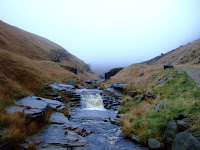
(The "river" Chew in Greenfield. My home village.)
I poked things with sticks, imagined huge waterfalls ahead, pushed my action man in his raft, generally anything but come to terms with the fact that I needed a friend.
I had to do the work in my head; we simply don’t have that many big rivers in England to stimulate the imagination. I put it down to generosity of spirit; with our 200 days of rain each year, we make sure that every village has a trickle running through it. Anything else would just be greedy.
That’s probably why I’ve never white water rafted before. The only white water I’ve encountered has been from industrial waste in the Thames.
When I heard it was done in Korea I had to try it. Before we travelled East to Inje, friends insisted the water would be calm; an easy introduction to the sport. Sadly it wasn’t to be. The day before, it rained as if an ark was needed. The whole sky was like an endless bucket being poured on all below it. The river raged up 2metres in a week, up a grade in a day.
It wasn’t a case of spotting the white water as we drove alongside the course, rather spotting the water that wasn’t. I could see all manner of rafting paraphernalia in the swollen water: paddles, helmets, arms.
I asked the instructor if it would be dangerous. He nodded. “It’s safe ...... verrrrry dangerous.” “So, it’s dangerous then?” “No, not dangerous, just a little not safe.”
This carried on back and forth. The instructor looked at another instructor and they told me various contradictory statements about the safety, or lack of it, of the rafting. The safety class was similar. We were told what to do if we plunged into a rapid. “Turn around, head up river, feet down river. Be verrrrry calm.”I looked at the waves rising up then crashing down into holes 3 metres deep. It didn’t seem conducive to calmness.
We got in the boat and practiced in the one calm spot for 10 minutes. This involved the guide shouting various instructions in Korean, the rafters shouting them back, and the boat spinning 360 degrees. He seemed pleased with this and so we set off into the first rapids.
Lindsay and I shared a boat with a group of high school exchange students from Singapore. They were confident, articulate and spoke in 2 languages, flicking back and forth between English and Malay, often mid sentence. The country has 4 official languages. Maybe their fluency can be put down to education; maybe that 42% of the country is of foreign heritage. Whatever it is if Korea really wants to be serious in its efforts to become a bilingual country then it need look no further than Singapore as a working model.
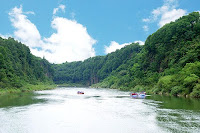
As we waited for the boat to drift to the first rapids and its doom I took time to look around. Cities in Korea are cramped, built upwards and generally devoid of any aesthetic pleasures. However, this does have a benefit. Much of the country is undeveloped, and in cities like Inje you can travel 10 minutes in a car and feel, as I did that day, like you are in true wilderness. Mountains rising up from rivers, entirely forested and seemingly full of adventures to be had.
(10 minutes from drive from the city of Inje brings you to this)
Then the rapids hit. We trashed our paddles around furiously, swayed from side to side, got soaking wet, but from the first swell I was hooked. There’s something extraordinary about being thrown about in a boat that is only comparable to when I’ve been mountain biking or fell running. You may not know entirely what you’re doing all the time, but that’s the draw card. You really don’t know what the result will be, because you don’t control every possibility. Nobody but nature does.
I started to get the hang of it, or at least I thought I did. We hit more rapids and guided through with no more damage than wet bodies. With 3 more rapids left we hit a big swell that rose the boat up and then dropped it mercilessly at what felt like a 90 degree angle. We all fell about, desperately clinging on. A girl was thrown overboard into the swirling abyss and the guide began to scream. Until that moment he’d be the epitome of calm. Perched precariously on the back of the boat and joking about. At one point I’m sure I saw him doing a handstand. Now though he seemed frantic. We were in the middle of a big rapid with a large slab of granite approaching. The problem with rocks is that they’re not in the habit of moving out of your way. Everybody grabbed what they could of the girl, whilst trying not to be thrown to the greedy river themselves. We finally hauled her on board and left her to lie at our feet.
She looked terrified. We managed to traverse the rest of the white water with no further incident, and it was then that I could consider the facts that make rafting so exciting. It really can hurt you. The water doesn’t help you out. It’s unrelenting, and so needs unrelenting respect and attention. That just deepened my addiction.
One of the best parts of outdoor sports compared to competitive sports is the removal of the competition. With that gone, your success doesn’t correlate to somebody else’s failure. It creates an atmosphere where people help each other out, and do their best to make sure you enjoy the experience. I looked up the river from our end point and the smiles were just the same as mine from boat to boat. If there’s ever a sport that sums up the spirit of Korean people, then it’s rafting.
The average person in the UK will spend 42 days in hospital over a lifetime. I’ve spent 12 in just the last 4 years before coming to Korea, so it wasn’t entirely surprising that I would receive some treatment during my time here.
It’s not that I’m especially sickly; most of my problems have been injuries. Damaging nerves in my hand after spearing myself with an electric toothbrush is a particular highlight.
My first trip to the hospital here was to deal with the dreaded swine flu, or piggus sickus to give it its Latin name. I arrived at the treatmentroom 5km away from the main building, on an island, over a moat reinforced with barbed wire, just in time to see the sign being changed from ‘keep out, leper colony.’
My next trip was to have an x-ray on my foot following a collision with a seemingly suicidal goalkeeper at football. This time I went to a different, smaller hospital; the choice is endless here in Chuncheon. I entered the building and was immediately given an appointment for an hour’s time. Coming from England I was expecting to be told to come a month next Tuesday, but only if it isn’t sunny, otherwise the old women will fancy a day trip.
From the time of appointment I was seen to, given an x-ray, assessment of the x-ray and prescription, all within 25 minutes. I’m still not sure what was wrong with my foot. He just kept pointing at my toes saying “abnormality, abnormality, abnormality,” whilst dancing about with some sort of staff, before sending me on my way to physical therapy. This involved a walk of 100m and no waiting.
They must have known I was English, because physical therapy involved the kind of treatment James Bond could expect to receive should he ever fail to escape the clutches of the enemy.
First a red hot bandage was wrapped around my foot. It was left on for 10 minutes, plenty of time to leave my foot medium to well done. I was told to lie down whilst they cooked my body parts, something the old woman in the cubicle next to me was evidently doing, as my bed shook violently with her snores. After the time was finished a nurse removed the pad and took it back to its rightful place removing wallpaper.
The middle part wasn’t as bad as a nurse rubbed gel onto my foot and moved a lump of metal over it. I had no time to ask what it did as straight away it was removed and replaced by two electropads. These proceeded to send electric currents through my foot. I did ask what these were. Her English was sketchy, but she managed to mention something about ‘stunning cows.’
As it turned on she pointed at a button and said ‘pain, press here.’ I nodded, lay back and relaxed knowing there was nothing a couple of pads could do to hurt me. Then it started. Waves of currents were sent through my bones. The first set forced my body upright, the second, gave me a twitch I’m still trying to get rid of. The next few went entirely through my foot, and gave it a similar to sensation to being crushed in a vice. After two of these I pressed the buzzer frantically. The nurse walked over, nodded and turned the power up. I screamed in agony and pressed the buzzer again, only to see her manically grinning as she turned it up still further. We played this game for 5 minutes before the power shorted out, the hospital lights started to dim and my foot began to smoke. Then I was allowed on my way.
Ignoring the devastating pain, and thinking of the time taken, for me the whole experience was fantastic. But therein lies the catch: for me. I can afford it. Millions can’t.
Certainly the old man I see near my apartment, bent double with arthritis, using a plank of wood as a crutch because he can’t afford treatment or crutches, can’t afford it. It’s an $8,000 a year minimum to be insured here, and that covers roughly 55% of your bills, only if you have work.
Nor can the woman who uses a pram filled with bricks to act as a makeshift walking frame. If you have no work, then you’re liable for 100% of your bills. Insurance just buys you the right to be treated.
In the other major country with no free healthcare, the land of the free, the USA, it’s a similarly shitty deal. 47 million people have no medical insurance. That’s more people than live in the states of Connecticut, Oregon, Iowa, New Mexico, Colorado, New York, Virginia and Utah combined. 2 million people a year file for medical bankruptcy in the USA, meaning every 30 seconds somebody has their life ruined because they’re unlucky enough to be sick, and couldn’t afford to be treated; all this in the richest nation on Earth. Of those people, more than half will have medical insurance.
University education is simply not an option for those at the lower end of the economic ladder. They have to spend their money on not dying. To be treated for leukaemia costs $500,000 and most insurance packages don’t cover that. 1 in 3 of us will get cancer at some stage in our lives. It’s a frightening enough prospect even without knowing you and your family will have to spend the rest of your days paying back debt, just to have a chance of survival.
There are hundreds of examples of insurance companies ruining lives with a loophole, just for a drop in their ocean of profit, but the argument doesn’t need strengthening. To make profit from people’s ill health is wrong. That simple.
An argument given by middle class people is ‘I have to wait too long for treatment.’ What a fantastically selfish, arrogant and small minded view. ‘Yes there may well be people being turned away bleeding from the hospital door because they don’t have the right forms, but there’s just no way I’m going to wait 3 hours for this x-ray.’
At least they’re waiting for something. Those 15 million in the USA with no healthcare could be hit by a drunk driver today and they won’t receive medical attention unless they have insurance. Even then they could well be liable for costs as their insurance company look for any way possible to not pay. In an age when $3 trillion dollars has been spent on the Iraq war alone, that is, in all senses of the word, criminal.
The second group of people perceived to benefit from a private system, in terms of reduced queues, is those with enough money to go private in any country. If you can afford the $8,000 a year to be treated in South Korea, then you can afford a full BUPA package in the UK, or to go private in France, Spain, Germany ...
Using queues as an argument is redundant.
Whilst my two hours of waiting and full treatment was a novelty here, I could easily have such an experience back home in England. I’m just not forced to pay if I don’t want to.
Still not convinced? Tell the amputee using a stick he’s carved himself to aid his walking because he can’t walk, due to not having treatment on his legs, as he can’t work to be able to afford the fees. Tell him no public healthcare is acceptable. And then try telling him with a clear conscience.
Can you do that? Then it’s time you signed up for private healthcare; you really can’t afford to wait.
The start of the World Cup, coupled with an Auntie and Uncle of mine moving to Brighton has had me thinking about a life changing moment of my own. A moment I finally admitted my true self to my father.
Before I did some research I was under the impression that Brighton is a place to move if you’re retired, a hippy, homosexual, or a combination of the previous. Some light reading soon revealed my ignorance; some students also move to Brighton, although they don’t pay taxes so I’m not too sure if they count.
Time in University, Sussex or otherwise, is similar to moving to Brighton, in that it is often a time when homosexuals can finally be themselves and live true to their hearts. They can finally go about their daily lives around liberal people, free(r) from bigots and self enforced celibate child abusing priests telling them that their desires are unnatural.
I have empathy for such a situation having been through a similar time of denial myself.
When I was still a primary school student I was an Oldham Athletic fan; a small team for my American readers, with an average attendance of around 5,000. I went with my dad most weeks. I talked the talk to my fellow fans, and even read the local paper to keep up to date with players. I was a committed fan; a signed ball in my room is proof of that, but all the while something didn’t feel quite right.
Cheering goals never came naturally; the appointment of a new fitness coach didn’t have me on forums. I just didn’t feel like other Oldham fans. I was unhappy and unfulfilled.
And then came Arsenal. As a 13 year old I found myself awake late one Saturday night watching Match of the Day. I didn’t need to watch it. As an Oldham fan I should have been indifferent as the news of an unknown Frenchman taking over a Premiership team was announced.
But little did I know how Arsene Wenger would come to change my life completely. Over the next few weeks I started watching MOTD in secret, with my TV turned down. I was thrilled at last. I was experiencing the pleasure the other boys got when they talked about Oldham.
Watching Arsenal was like a dream, like nothing I’d ever seen before. The ball was passed around on the floor. They didn’t kick people. They were playing football. I’d found myself, but it would be years for me to come to terms with it.
Right into my 20s I watched the Gunners in secret, making games I did see look like a coincidence. I’d go to Arsenal friendly bars, and then ignore the people I’d watched games with if I saw them on the street. If I watched Arsenal in a regular pub I’d put my jumping up when they scored as cramp, shouts of yes were because of a polite form of tourettes; anything to avoid people knowing I wasn’t really an Oldham fan.
Something had to give. I was living a lie, and lying to those closest to me didn’t sit comfortably. I began to confess to my friends. I told myself in the mirror I was an Arsenal fan, then it was friends who didn’t care about football. A trial run of coming out. It felt like a weight had been lifted every time I said the words “I’m an Arsenal fan.”
Eventually I let thing slip, I’d argue the qualities of Pascal Cygan with such gusto that people knew something was wrong.
Some guessed, some I told and some simply asked me outright. Soon there was nobody that didn’t know. Nobody except my father.
I told him over and over again in my mind, but each time it came to doing it in person I bottled it. I was too choked with emotion that I just ended up asking him the time. He was never quite sure why this was ‘big news,’ nevertheless I couldn’t come out. I didn’t want to upset him.
Then came a charity hike with friends. My dad was the driver, taking us to various mountains to climb, all in the aid of a good cause. The discussion inevitably turned to football, at which point a member of the group, that I didn’t know as well, asked that question:
“Who do you support Lewis?” The friends that knew looked around uncomfortably, twiddling thumbs, silently whistling, doing anything to avoid eye contact. One friend even blinded himself with a penknife just to make sure.
I waited one second....two seconds....three seconds. My dad turned and looked at me. I could see it in his eyes ‘what’s the rush son? It’s an easy question.’ I couldn’t do it anymore.
“Arsenal.” It shot out like a bullet. I’d confessed. I turned to look at my father. The man who made me, who would look to me to pass on the family name. He just smiled and turned around to look at the road and switch the radio to five live; the Arsenal game. Turned out I had no reason to worry after all. I sighed as he began to talk:
“Now, you know who was a great defender? Pascal Cygan.”
It’s 1915 France. Trenches oppose trenches. Faces face faces. Guns point at guns. Europe is at a stalemate. Neither team will give in. It’ll take 3 more years, 16,000,000 deaths and cultural devastation before the deadlock will be broken. It could have all been so much simpler; if only somebody had uttered those immortal words: “rock paper, scissor!”
It’s 2010 Korea. Two students stare each other down in class. They want desperately to give each other Chinese burns, flicks to the face, water boarding; all manner of things considered illegal under the Geneva Convention. (Read: OK ways to kill other people) On of them utters those immortal words: “Kari, bari, bo!”
Rock paper scissor, or kari bari bo, to give it its Korean name, carries genuine weight over here. If a standstill unfolds, a last pizza slice is being sought by more than one, or a decision about immigration policy is splitting the cabinet; there’s only one way to resolve things in Korea, and the people have it down to a fine art. People limber up before hand; celebrate victory like a world cup. I saw one man running in the mountains training for a particularly tough rock paper scissor contest.
My students first educated me in the ways of kari bari bo (it must be said in full each time, to shorten it would only devalue the bo, although I have no idea which that one is) and I presumed it was limited to school debates over distribution of pain and reading duties in class (to many students those aren’t mutually exclusive events.)
However, I underestimated the cultural reach of the game. Soldiers will use it to distribute duties, professional men to decide who gets the final soju shot. MPs over what to claim next on expenses.
It really does take over everything.
Both of you want to watch a different film? Kari bari bo! Not sure where to holiday this year? Kari bari bo! Debating which oil laden Middle Eastern country to invade next? Kari bari bo!
Despite all this, the system would just fall apart were it not for the fact it is adhered to strictly. If somebody loses they will perform what is asked of them with no question.
I even read of a criminal ring that has recently emerged in Seoul, filled with people playing Russian kari bari bo, or ножницы утеса бумажные in native tongue. The winner takes all the loser’s possessions, whilst the loser is killed by the hand that beat them. I.e. death by either rock scissor, or rather more trickily, paper. Being paper cut to death is pretty high on my ‘top 10 list of ways not to die.’
Both Koreas are technically still at war, since no armistice has ever been signed. It’s surprising the whole thing hasn’t being solved by kari bari bo, although, to be fair, in Kim Jong-Il’s case it would most likely be rock scissor nuclear warhead.
So why not tale a little Korea culture into your life today? Next time you’re mulling over debates such as: spend or save, holiday or house, jump or don’t jump; take the stress out of life. Just limber your wrist, pull back your arm and utter those immortal words: Kari Bari Bo!
Not to sound smug about it, but my blogging has been tempered of late, due to the glorious weather we’re experiencing here in Korea.
It’s been hot, but not too hot, with a little wind and almost entirely dry; perfect weather for soccer, cricket, tennis – all manner of outdoor activities. And so it was that last week I found myself in a dingy student’s union with windows, playing ping-pong with a Jehovah’s Witness.
Mental lapses aside, Brian is a nice guy, and so I agreed to play. In England, compared to the layman, I consider myself a decent table tennis player. Those who know their way around a table will most likely beat me, but those who ask what end of the bat to hold may fall to my less that dramatic spin. Brian claimed to be the same. I envisaged an even match. A gruelling encounter of Federer Roddick proportions. Two men sweating enough to rehydrate an African nation, grunting with all their masculine might; enough to make even the Williams’ sisters jealous.
It wasn’t to be. He destroyed me. The warm up went well enough. We traded gentle rallies, chatted between points, and occasionally during. It was all very lawn tennis. At one stage I found myself flirting with a vicar’s daughter whist Brian made us Pimms. I had found my calling card. A sport I could do without actually having to do much.
But then we started a real game. I took the first point and all was going well, but then Brian switched. Like the old man at the end of Street Fighter, he suddenly changed. Red ran into his eyes. He ripped his shirt through sheer muscle growth and began to scream. Then the massacre took place. I was well out of my depth in a sport that became scarier than I could imagine sport involving a 2gram ball could be. White bullets rained on me until 5 minutes later the torture was ended by a grinning Brian saying 11-1, do you want to play again?
He had told me he was only average, and the scary thing was, compared to other Koreans he is. I looked to the table next to me at two students having a quick rally before a night out. It took the ball stopping for me to realise there even was one. All I could see was a blurry white line linking their bats.
Ping Pong needs the kind of skills that Koreans excel at, the rest of Europe see as important, but we in Britain often struggle with in sport: technique, finesse and intelligence. Especially in football, the difference between Europeans and Koreans, is those skills are coupled with a strictly enforced honesty in Korea.
I play 5 a side on pitches around the city. The pitches have teams waiting around the edges and operate with 2 rules: first to 3 and winner stays on. There’s never a referee, but there’s no need. Honesty is expected, and so is self enforced. Handballs are admitted and fouls apologised for. In my entire time here I’ve played 5 a side over 30 times, and I’ve seen a disagreement once.
Teams order themselves on the side to determine who goes on next. There’s never a problem, just honesty. It truly is a fantastic thing to behold. Should the same thing happen in England, especially in a city centre, there would be arguments by the minute, voices raised as standard, and most likely a knife would enter the equation at some stage.
In 11 a side games, even with a referee, it’s exactly the same. Players won’t complain if they’re judged offside, they just get on with the game. There’s no nasty tackles ‘to let people know you’re there.’ If they handball and the referee doesn’t see it; no problem, it’s admitted to anyway. People here remember football is a game, to be enjoyed. The result won’t change a thing, and as long as they’ve given their all, which their tremendous work ethic demands they do, Koreans don’t let it change their mood either.
The best part is: it’s infectious. You can’t help but do the same. When such standards are expected as the norm, it creates an environment where you don’t want to look like the worst person on the field, an environment where nasty fouls aren’t cheered by small minded thugs, but condemned by all those watching; the perpetrator made to feel, rightly so, guilty.
In Korea, football really is the beautiful game, honestly.
The 1999 Bronze Medal winner from the annual blog awards, in the catagory 'Ok blogs about people called Lewis who move from the North of England to South Korea and back again.'
Other stuff to read when you've read all my blogs twice over
Scroll down far enough and you can read about my time living in South Korea.
If you like your blogs cooler and more relevant then read the new stuff about an angry Northerner's journey through life.



 Posts
Posts


