Sunday, 12 September 2010

This Blog is live from Bingley

There’s something wonderfully British about festivals. Whether it’s a simple village fete, a cider pressing party, a scarecrow festival, a bonfire parade, or even something grand like Notting Hill or Glastonbury; the variety of gatherings is only matched by the range of nutters, crazy folk and general wierdos that you can find at them.

Plenty of other countries have festivals, but I doubt many countries can manage the range of oddities prevalent in the UK. There’s always somebody dancing to no music, wearing clothes that look like they’re still growing or possessing a collection of badges that has taken decades to amass.

How these people afford it is a mystery. Take Glastonbury for example. Tickets are now £180 for the weekend, that’s before you take in costs for food, drink and most of all, transport. I’ve been to the village of Glastonbury and I remember distinctly trains that only ran when the driver woke up, and the nearest highway of any sort being 311 miles away. Yet it has hundreds of nutters, all of them seemingly working away in various offices, schools, fields, zoos near you.

I went to a couple of festivals in Korea. They were fun, and they even had people in costumes, but those people were laughing and joking with friends. There were no true mentalists. The costume was exactly that. A real crazy man wears a suit made from dandelions not for a laugh, but because that’s just the clothes he wears. That home done piercing filled with a bent fork is that way because that’s what he had handy at the time. Nutters don’t try, they just are.

So when a friend of mine asked me to a music festival over the weekend just gone, my ears pricked. When he said it was in Bingley and only cost £30 I bought a ticket straight away. Cheap and in Bingley, a more fertile breeding ground for nutters there surely never has been.

The festival started on the Friday night and passed mainly without incident. The beers were of festival standard, overpriced and underflavoured, but there was an added bonus. One could earn 10p for every cup given back. In theory this was an excellent idea; it promoted recycling and reducing litter. In practise it led to hoards of children scurrying around feet collecting dropped cups. They swarmed like rats throughout the crowd; some were even urinating to mark their cup collecting territories. I escaped the crowds to order a pint, only to see it swiped from my grasp by a chalice hungry minion.

The Saturday was basked in sun, weather which added to the middle class feel of the whole festival. Most people were sat down with picnics they’d brought. It made crowd surfing tough, and a few people weren’t happy to have me jump on them as they tucked into their kettle chips. However it all kicked into gear with the last two bands. The penultimate act was John Lydon’s band Public Image Limited to be followed by James. On the face of it they were similar, two bands coming back after breaks and both promoting new material. Sadly that’s where the comparisons end.

PIL walked out, and after putting on their instruments they set up their music books to read from as they played. That didn’t bode well. They used them constantly during the performance, meaning no connection with the audience. John Lydon, in his true punk ways, spent the money he earned for doing a country life butter commercial, reforming PIL. He obviously overlooked time learning songs when planning his budget.

A member of the crowd, obviously angered by such an appalling lack of effort, threw his plastic pint at John. It hit him on the shoulder and spilled beer over him. His response was ‘wankers, beers is for drinking, not throwing.’ And so it began.

John was pelted throughout his reading of lyrics, and each time he responded by abusing the audience. According to one NME review, his famous on stage tirades are straight off the cuff and come from within. When John started with ‘We don’t want your government Blair,’ I began to have my doubts. Towards the end he lent his face to the crowd and asked repeatedly ‘can you smell the onions? Can you smell them fucking onions?’ He stopped when a burger was thrown at him. It just added to an image of an old desperate man looking to be part of a world where he is longer relevant. I felt sorry for him.

James, on the other hand, needed no sympathy. I can’t claim to be a loyal fan. I’ve never seen them live and my listening to them is limited to the radio and bars, but from the first bar of their first song Sit Down the whole audience, including me, were hooked. Tim Booth sang and danced with the passion of a man who has been playing gigs for a year and still in love with his music, not a music veteran who’s been touring for 18 years. For recognising how lucky they are and how important the connection with your audience is, I’ll raise my glass to James. At least I would if some kid hadn’t stolen it to sell.

Thursday, 2 September 2010

Tony, Toni, Tone

Tony Blair’s memoirs are well on their way to becoming the fastest selling in British history. On pre sales alone it shares the top 3 current bestsellers with the autobiographies of Alistair Campbell and Peter Mandelson; we do love a good monster story in Britain.

Usually when somebody provokes such ill feeling as Blair, there are a number of reasons for it. Being hated to the point where a million march against you takes some doing. Thatcher stole industries, jobs, communities before she finally rose to full on hatred with the theft of milk.

With Blair, however, there was just Iraq. His smug smile was irritating. Hobnobbing with celebrities and pretending to be a football man both showed a man desperate to be liked, but nobody died. He was just a bit of a loser. That was OK though, people can deal with a loser when unemployment is falling, hospital queues are being slashed and the minimum wage is increased yearly.

Seeing 179 British soldiers dying to stop weapons that never existed managed to take Blair from OK loserish guy, to hated war criminal pretty much overnight.


On Parkinson Blair said he prayed to god for answers about the invasion of Iraq. He then went on to say “You realise that judgement is made by other people... and if you believe in god, it's made by god as well."

When I was at University there was a man who used to walk around the local town centre. He would collect cans, put them into a black bin bag liner and carry them to the same spot at the same time every night. There he would proceed to stamp on the bag and shout “BAD CANS, BAD CANS – THE DEVIL IS IN YOU AND HE MUST COME OUT, BAD BAD CANS!”
That man was unsurprisingly taken in for medical care after a few weeks. He was guided by the voice of god, and yet all that was damaged were a few cans.

There was also a Muslim student who used to tell people outside the student’s union bar that they were being judged by god; that bad things would happen to them in the after life if they continued down their path of sin. He was warned by the University not to go near the union unless he could keep quiet, and yet all he did was talk to us.

Strange then that when, guided by god, and passing judgement on his / her behalf, Tony order the invasion of Iraq and with it the death of 700,000 civilians, he was worried that people in Britain would think of him as a ‘nutter,’ because he was Catholic not Church of England.

Strange also that Blair would describe Gordon Brown as a man with ‘zero emotional intelligence.’ That from a man who patronised the British people so severely by stating they couldn’t accept a leader of another religion.


As thousands working in the public sector are currently looking over their shoulders, worried that they’ll be swept away in the next wave of cuts, one wonders what word they’d use to describe Blair, the man who instigated and authorised the spending of £9.24billion on invading Iraq.

The word ‘nutter’ comes to mind.

Monday, 30 August 2010

“I’d punch you. Punch you right in the mouth.”


Today’s difference isn’t strictly between Korea and England, rather America and England, although a night out in parts of Seoul often merges USA and Korea into one.
Show an American a room full of flowers and they’ll tell you how wonderful they look. They’ll tell you how much they love flowers, even if they don’t. You’ll end the meeting feeling good. Show somebody English the same room and they’ll ask where the coffin is.

One night in a bar in Chuncheon I had a conversation with two American guys on the topic ‘top five people you’d like to meet.’ It was full of positivity as we discussed our heroes and how they’ve shaped our lives.

On my first day back in my Oldham office a colleague asked me: “If you could punch 5 celebrities flush in the face, who would they be?”

In the spirit of national pride here is my punch list. The rules are that the punches are to the face, will not kill or leave permanent marks and they are also without repercussions, so if there’s a famous woman you dislike, fret not, punch away; it’s only a blog.

Shane Ritchie

My first answer and it was made immediately. I’m not entirely sure why I’ve always despised him. Maybe it was his smug smile as he replaced people’s stained shirts with new ones and claimed Daz did it(it takes a special kind of desperation to pick up Danny Baker’s rejected jobs). Perhaps it was the needless abuse he dished out to Peter Simon during his time as presenter of Run the Risk. More than likely though it’s because one of his boys is called Shane jnr, and another is called McKenzie Blue. Anybody who puts a colour in their child’s name is practically asking to be punched.

(Punch me, punch me right in the face)

Garth Crooks

Football is a world that’s easy to hate, and there’s plenty of punchable people. It could be Ashley Cole: “55k a week is taking the piss.”
Sepp Blatter: “Women should wear tighter shorts.”
John Terry: “I just had sex with your wife.” (lawyer’s note, this is not a genuine quote)

But all of these will feature on so many punch lists. I like to spread the wealth and so my football man is that ditherer of questions, that confuser of events that have just happened. A man whose fourth most searched for term on google involving his name is 'Garth Crooks Idiot.'

Garth Crooks (shouting): “That should never have been a red card, only ever a yellow card.”
Steve Claridge: “It was his second yellow card Garth.”
GC: “But still.”

His job started at the BBC as a post match interviewer, and it’s not hard to see why when he excels in that art with hard hitters like this:

“That was clearly the result you wanted wasn’t it?” (To a Dutch player after they’d won 3-0) or even this question made to Arsene Wenger:
“David Seaman made a phenomenal save today. Is he capable of saves like that?”

Such a poor performance in such an easy task as asking coherent questions would have most people fired, but sadly Garth has just moved further up the pecking order at the BBC and into that realm of football pundits that really shouldn’t be eating unassisted, never mind offering their insight into the game.

Imagine if a journalist was to interview a celebrity and just asked ‘You’re good, aren’t you?’ Or a doctor that asked ‘It hurts when you move your knee. Are you capable of moving your knee?’ A world full of Garth Crooks is a frightening prospect and for that reason he deserves a punch.

Chris Moyles

Chris Moyles is the peak of the Radio One Iceberg. That’s not to say I don’t want to punch him on his own merits, but in this case he’d be taking the punch for the whole of Radio One, especially the news desk.

I love the BBC. It makes me proud to be British. The website is magnificent, the shows are generally of high quality, and it shows why privatisation isn’t always the best way. Programmes get made by the BBC that don’t make money, but are quite clearly high points of our culture. Think of Blue Planet, The Thick Of It and Have I Got News For You. These are programmes that don’t insult the intelligence, that promote knowledge and are made by people at the top of their professions.

Sadly Chris Moyles and Radio One are the antitheses of these qualities. The breakfast show seems to consist entirely of Moyles talking about ‘funny things I said in the pub’ all of which have been written by producers. If there’s one thing worse than bombing, it’s bombing other people’s material. Such funny things include shouting down the microphone, referring to a ringtone as ‘gay’, introducing himself to Halle Berry as a ‘big black man,’ saying Polish people make great ‘prostitutes and ironers’, and having footballers on his show who say the word ‘faggot’ without reprimand.

Radio One news is no better. BBC news should be a bastion of impartiality and informed comment, and yet it allows Radio One to constantly follow up its new reports with opinions of the public disguised as intelligent statements, such as “James from Luton says ‘I think the floods in Pakistan are terrible.’” Really James? How informative; I may have struggled to have come to such a conclusion had I only been presented with the raw figures of 3,000 dead.

“Chelsea from Salford thinks ‘Them MPs aren’t right, they need to be sorted out.’” Fantastic Chelsea; would you like that to be implemented as a policy to tackle Government corruption? Just as simple as sort them out. If only such laws had passed but 5 years ago, think of the waste that could have been avoided.

For this and for only ever being Northern when it suits you, Chris Moyles, given the chance I would punch you full in the face.

(How has this man made money?)

Paris Hilton

To keep this blog from being accused of sexism I have decided to include a woman. Namely Paris Hilton. As a child I was well taught in the ways of the world by my father, and so I know never to trust anybody with a monobrow, anybody who wears a hat with no practical purpose and women who carry dogs in bags.

Through no fault of her own Paris sums up the worst in rich children who really don’t have a clue, and don’t really need to, because even if they flunk everything, they’ll always have money.

“All British people have plain names, and that works pretty well over there.”

No Paris they don’t, just ask Shane Ritchie.


Number 5

I do my best to make the blogging experience as interactive as possible, and because of this, and in no way due to my laziness I have left the 5th option open to public discussion. Who would you punch in the face? You get to leave a comment at the bottom and I get more dwell time on my website; it's a win win situation.

Blog away reader, blog away.

Friday, 27 August 2010

Scroats


Scroat - [scrote]
-noun
Difficult to define, but people who aren’t scroats can generally tell if somebody else is. A scroat often be seen stealing from old people, shouting at their partner when pissed or generally just doing scroaty things. Scroats often congregate into groups with other scroats. They can be indentified by a constant need to massage their testicles. They’re often seen being walked by dogs that seem intent on killing anything that crosses their paths.

My neighbour is a scroat. I know he is because when he’s drunk at weekend he calls his girlfriend a slag. I can tell she’s a scroat too because she stays with him. For all their faults scroats tend to be fairly loyal, perhaps because nobody else will hang out with them.

On my return to England I was amazed by the sheer quantity of scroats, I counted 42 outside one shop alone. Korea is mercifully free of them. There’s no sense of cool if you’re stupid in school or any sense of ‘well done’ if you’re somebody who cheats or steals.

Much like honesty and decency spreads through all walks of life in Korea, so Scroats infest English culture like rats. Footballers dive and go on strike to top up their millions, led by big time Scroat Ashley Cole. Celebrity TV shows are made to cater for them, and even political parties like the BNP exist, should they ever become inspired to vote.

One day soon they’ll be a Scroat religion with a leader who wears all white and ridiculous quantities of gold. He’ll lie, cover up crimes and blame everybody else when he’s caught.

Wait a minute ...


Thursday, 26 August 2010

Neighbours

Apartment living has its benefits: Heating bills are kept lower, there’s no garden up keep and you don’t have to negotiate any tricky steps when you’re drunk. However, it does mean your access to neighbours is limited to looking into their living rooms across the carpark.

During my time away in Korea our house was rented out. For the most part the tenant left it in one piece, however, a gardener he was not, and so my first job on returning was to tidy the garden as best I could. The first two priorities were cutting the grass and removing a vine plant that had gotten out of control. To do both jobs I borrowed a pair of blunt shears.

After hacking at the grass for some minutes I finally removed two blades. Exasperated I moved onto the vine plant. When I left England it was growing, but was a manageable size. Now it was a beast of epic proportions. As I removed leaves I saw the remnants of eaten plants, scores of crushed snails and the bones of next door’s cat that went missing. It seemed impenetrable, especially so since my tools had developed a layer of rust that chipped off only to reveal older rust. A Russian doll of rust lay beneath.

After an hour of squeezing leaves between the ‘blades’ my neighbour, whom I have never spoken to, offered to lend me her secateurs. The offending plant was massacred in minutes. My gloveless hands bled as it went down fighting, but I kept on. It went deeper than I thought possible. The inside was a graveyard of bugs, plants, snails, Russian spies. As I went under the leaves to cut the plant at its main stem I felt the branches closing in on me, but despite its best efforts I cut it down to the roots. All thanks to the kindness of neighbours, neighbours I never would have spoken to had I lived in an apartment.

Having said all that my other neighbour is a twat.

Wednesday, 25 August 2010

Going home

Korea was an easy place to live. 27 hours make a full time week, a meal out costs a fiver, beer is plentiful and work starts late. However, because of this, it isn’t the healthiest place. Like a tree’s age can be counted by its rings, generally you can tell how long a teacher has been in Korea by how many extra inches they have around their waist since they arrived.

Despite having an incredible year full of new experiences and new friends, leaving Korea, for my health’s sake at least, wasn’t all sorrow. Nobody wants to be the last to leave a party, but it’s hard to be the first.

(Perhaps the best ever song about going home, apart from Driving Home for Christmas by Chris Rea obviously)

Different people have different responses when it comes to the time to go. Some count down the days on their facebook walls as if the whole thing was a prison sentence. Some people cry, some people just stay. For the most part people are mixed like I was. Heading home my first feeling was joy at seeing my family. Actually my first reaction going home was ‘Finn Air – £500 for excess baggage – robbing bastards!!!,’ but after stealing a cushion and headphones from the flight, my sense of justice was restored and I went back to being happy at seeing my family. That was followed by sadness. Not at the end of the highlife, Korea is as close as one can be to being back at university, but without the need to eat baked beans for 42 days straight. I was sad at the fact that due to their homes being in USA, Ireland, Australia and Canada, I probably wouldn’t see my new found friends again.

With regular travelling people come and people go, and that’s part of the deal. You know you’re probably not going to see them again, so moving on isn’t hard. However to live in another country for a year means to put down roots. Friends are made and plans are made with them. Your life is a normal life, but in another country. When the time comes to leave that means not just leaving a country, but your friends, groups, plans, local bars, favourite restaurants, colleagues and hardest of all in my case, students.

The culture shock I experienced going to Korea was only eclipsed by the culture shock going back to England. In the spirit of easy reading, starting tomorrow, each day I’ll be posting the main differences between the two countries.

Tune in tomorrow for the first difference: neighbours.

Friday, 23 July 2010

A river ran through me


It’s said the Inuit have over 100 words for snow. Likewise we English have a whole collection of words for small body of running water with no obvious danger: stream, brook, spring, creek, course, rivulet, spate, pissflow. A river is something big, something to be feared and crossed on a bridge; to be looked at from a distance and admired.

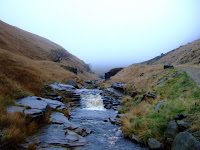
A stream is where I got my running water kicks as a kid. I used to journey down brooks in my wellington boots. There was no need for waders; the water never rose above my toes, but still it felt like an epic journey each time I traversed the watery mile to the local tennis club.

(The "river" Chew in Greenfield. My home village.)

I poked things with sticks, imagined huge waterfalls ahead, pushed my action man in his raft, generally anything but come to terms with the fact that I needed a friend.

I had to do the work in my head; we simply don’t have that many big rivers in England to stimulate the imagination. I put it down to generosity of spirit; with our 200 days of rain each year, we make sure that every village has a trickle running through it. Anything else would just be greedy.

That’s probably why I’ve never white water rafted before. The only white water I’ve encountered has been from industrial waste in the Thames.

When I heard it was done in Korea I had to try it. Before we travelled East to Inje, friends insisted the water would be calm; an easy introduction to the sport. Sadly it wasn’t to be. The day before, it rained as if an ark was needed. The whole sky was like an endless bucket being poured on all below it. The river raged up 2metres in a week, up a grade in a day.

It wasn’t a case of spotting the white water as we drove alongside the course, rather spotting the water that wasn’t. I could see all manner of rafting paraphernalia in the swollen water: paddles, helmets, arms.

I asked the instructor if it would be dangerous. He nodded.
“It’s safe ...... verrrrry dangerous.”
“So, it’s dangerous then?”
“No, not dangerous, just a little not safe.”

This carried on back and forth. The instructor looked at another instructor and they told me various contradictory statements about the safety, or lack of it, of the rafting. The safety class was similar. We were told what to do if we plunged into a rapid. “Turn around, head up river, feet down river. Be verrrrry calm.”I looked at the waves rising up then crashing down into holes 3 metres deep. It didn’t seem conducive to calmness.

We got in the boat and practiced in the one calm spot for 10 minutes. This involved the guide shouting various instructions in Korean, the rafters shouting them back, and the boat spinning 360 degrees. He seemed pleased with this and so we set off into the first rapids.

Lindsay and I shared a boat with a group of high school exchange students from Singapore. They were confident, articulate and spoke in 2 languages, flicking back and forth between English and Malay, often mid sentence. The country has 4 official languages. Maybe their fluency can be put down to education; maybe that 42% of the country is of foreign heritage. Whatever it is if Korea really wants to be serious in its efforts to become a bilingual country then it need look no further than Singapore as a working model.

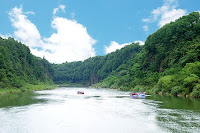
As we waited for the boat to drift to the first rapids and its doom I took time to look around. Cities in Korea are cramped, built upwards and generally devoid of any aesthetic pleasures. However, this does have a benefit. Much of the country is undeveloped, and in cities like Inje you can travel 10 minutes in a car and feel, as I did that day, like you are in true wilderness. Mountains rising up from rivers, entirely forested and seemingly full of adventures to be had.

(10 minutes from drive from the city of Inje brings you to this)

Then the rapids hit. We trashed our paddles around furiously, swayed from side to side, got soaking wet, but from the first swell I was hooked. There’s something extraordinary about being thrown about in a boat that is only comparable to when I’ve been mountain biking or fell running. You may not know entirely what you’re doing all the time, but that’s the draw card. You really don’t know what the result will be, because you don’t control every possibility. Nobody but nature does.

I started to get the hang of it, or at least I thought I did. We hit more rapids and guided through with no more damage than wet bodies. With 3 more rapids left we hit a big swell that rose the boat up and then dropped it mercilessly at what felt like a 90 degree angle. We all fell about, desperately clinging on. A girl was thrown overboard into the swirling abyss and the guide began to scream. Until that moment he’d be the epitome of calm. Perched precariously on the back of the boat and joking about. At one point I’m sure I saw him doing a handstand. Now though he seemed frantic. We were in the middle of a big rapid with a large slab of granite approaching. The problem with rocks is that they’re not in the habit of moving out of your way. Everybody grabbed what they could of the girl, whilst trying not to be thrown to the greedy river themselves. We finally hauled her on board and left her to lie at our feet.

She looked terrified. We managed to traverse the rest of the white water with no further incident, and it was then that I could consider the facts that make rafting so exciting. It really can hurt you. The water doesn’t help you out. It’s unrelenting, and so needs unrelenting respect and attention. That just deepened my addiction.

One of the best parts of outdoor sports compared to competitive sports is the removal of the competition. With that gone, your success doesn’t correlate to somebody else’s failure. It creates an atmosphere where people help each other out, and do their best to make sure you enjoy the experience. I looked up the river from our end point and the smiles were just the same as mine from boat to boat. If there’s ever a sport that sums up the spirit of Korean people, then it’s rafting.